Replaced a 30-Year-Old Nurse Call System on an Active 96-Bed Med-Surg Unit. Zero Clinical Downtime.

At a Glance
| Operator | [Community hospital, Illinois — sanitized] |
| Facility | 96-bed med-surg unit + ED |
| Scope | Jeron P790 replacing legacy pull-cord and aging head-end |
| Timeline | 14 weeks design + cutover; 4 weeks installation |
| Integration | Cerner workflow; existing nurse mobile devices |
| Outcome | Zero rooms out of service during cutover; every bed stayed live on a room-by-room migration |
The Problem
The nurse call system had been installed in the early 1990s. Proprietary wiring, discontinued head-end hardware, and a parts market that had dried up years earlier. The facilities team was sourcing replacement components on eBay. When a station failed, the repair was a workaround, not a fix — and the clinical staff had learned not to trust the system for anything beyond the most basic call function.
The Joint Commission had flagged an EC.02.05 finding at the last survey cycle: the system was not reliably delivering alarms to the correct station, and the documentation trail was inadequate. The finding had a deadline. The hospital needed a replacement, not a repair.
Three operational constraints made this harder than a typical replacement: the unit was running at 92% occupancy with no decant beds available, NFPA 72 required a coordinated fire alarm interface that brought the local AHJ into the approval process, and the capital budget had a hard close date that couldn't slip. Any approach that required rooms to be taken offline sequentially — the standard approach — would have violated the occupancy constraint before the project was half done.
What We Did
01 — Discover
Our healthcare systems engineer spent two days on site — including shadowing a med pass and a code response — before producing a design brief. We documented every station, identified the NFPA 72 interface points, confirmed the Cerner integration requirements with IT, and produced a constraint map: what had to stay up, what could be sequenced, and what the cutover windows looked like given census.
02 — Design
The P790 design used the existing conduit where it was reusable, new cabling in a parallel run where it wasn't. We designed the cutover sequence to allow every room to stay occupied by running new wiring to the new head-end while leaving the old station live until the switch. Drawings were submitted to the AHJ for the NFPA 72 coordination and approved before mobilization.
03 — Estimate
Line-item estimate tied to the design drawings, with a fixed allowance model for field conditions. Contract pricing under the hospital's GPO reduced the material cost below open-market pricing. The estimate included a phased payment schedule aligned to the capital budget close date.
04 — Install
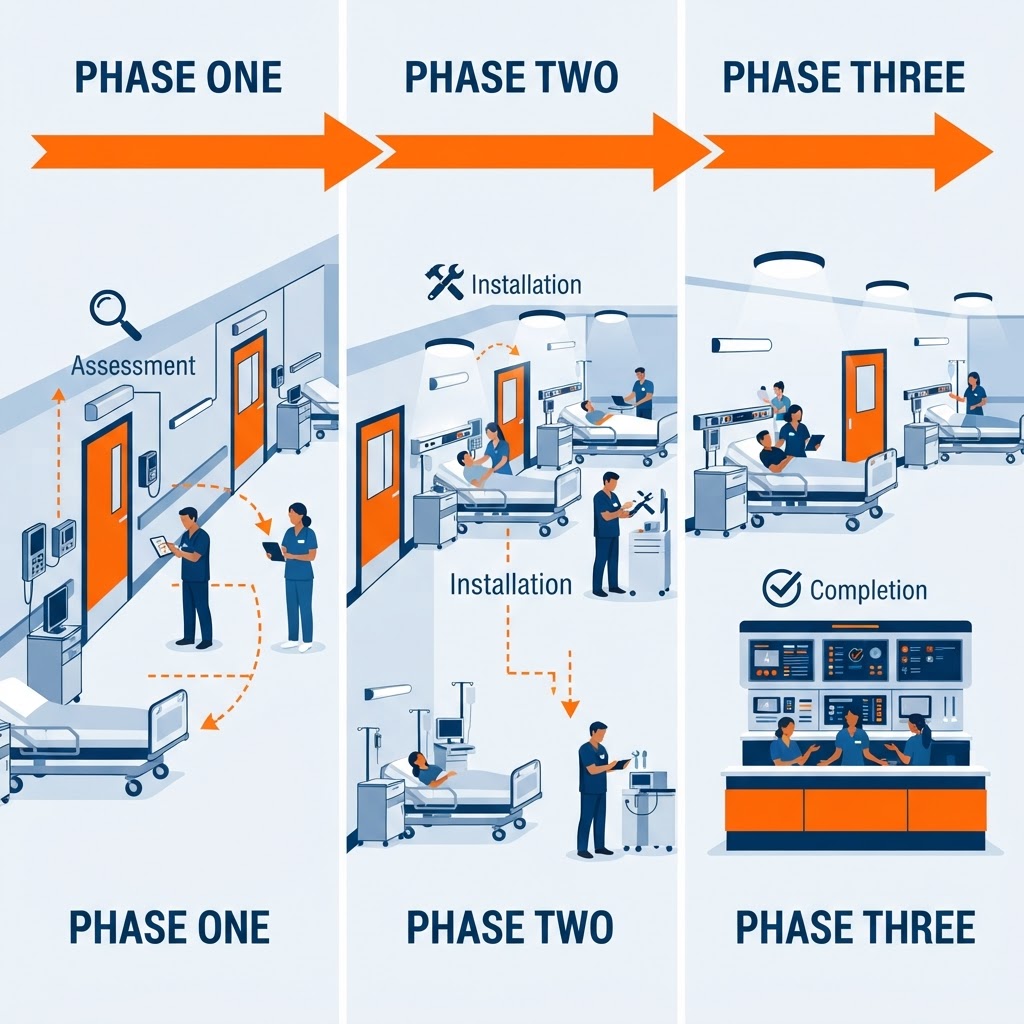
Four-week install with an ICRA-credentialed crew. No room was taken out of service at any point. Each cutover was performed during a shift change window — typically 2–4 a.m. — with a written rollback procedure in place and a Nexus engineer on-site for every cutover event. The clinical supervisor was notified 24 hours before each wing transition.
05 — Manage
System transitioned to a Nexus360 managed agreement at closeout. Jeron is the primary vendor relationship; Nexus manages escalation and first-response. The hospital's facilities team received a training package, record drawings, and a first-year service calendar before we demobilized.
The Result
- Zero rooms taken out of service at any point during the cutover sequence
- Room-by-room cutover kept every patient bed live — no unit ever went offline during the migration
- Joint Commission EC.02.05 finding cleared at next survey cycle
- Single audit trail for all alarm events, accessible from the Jeron head-end
- Cerner integration live at go-live — no post-cutover integration sprint
What This Required From the Operator
Approximately 60 hours of staff time over 14 weeks — primarily the clinical supervisor for cutover coordination, IT for Cerner integration testing, and facilities for AHJ permit access. A comparable open-RFP procurement process would typically require 200+ hours of procurement, contracting, and vendor-management time before a crew ever arrived on site. The cooperative contract pricing removed that overhead entirely.
"We've done nurse call replacements before where half the unit was offline for six weeks. This was different — every room stayed live, and the system worked the way Jeron said it would, from the first night."
— Director of Facilities, [Community Hospital, Illinois]
Ready to modernize nurse call at your facility without taking a unit offline?
Our engineers respond within one business day with a custom scope — no obligation.
Call 847-443-9900 · 1171 Tower Road, Schaumburg, IL 60173 · Request consult