One Contract. One PM. One Playbook. Every Site.
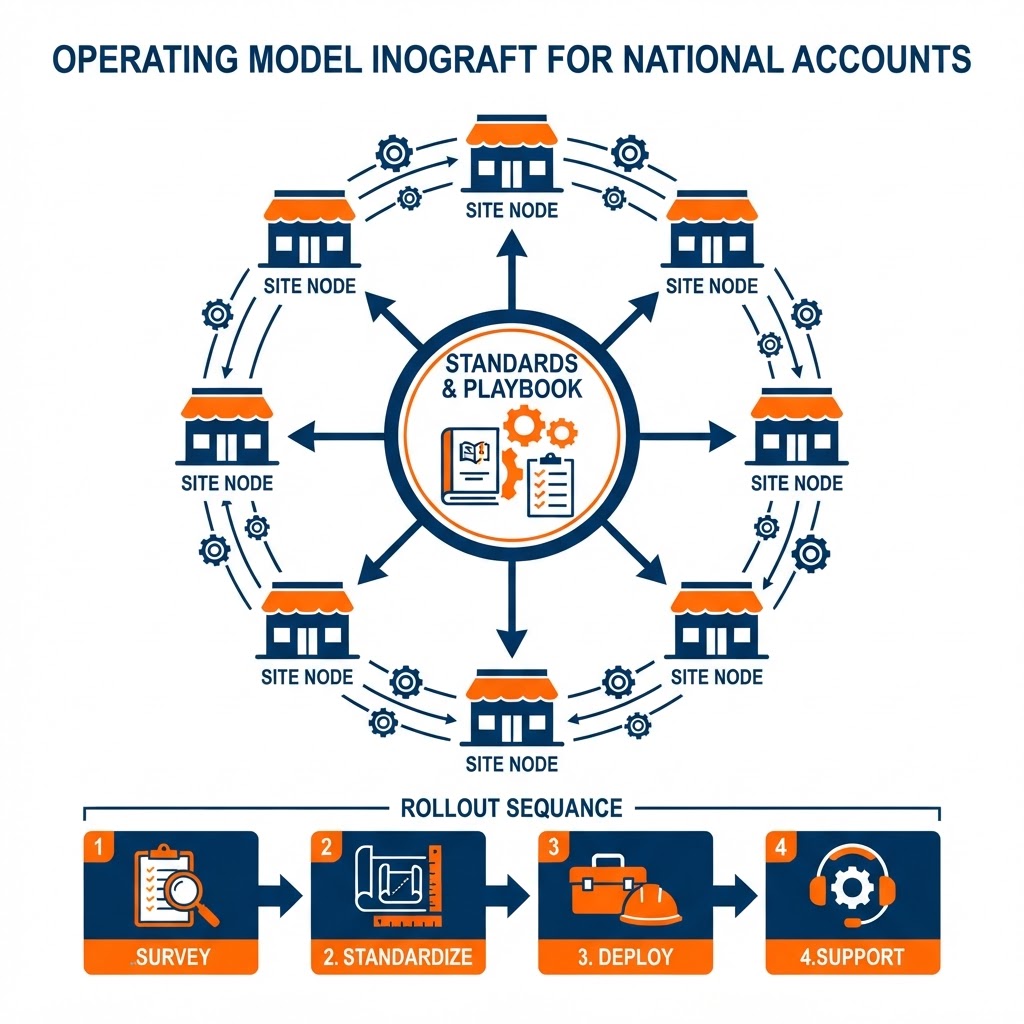
When you operate seven senior-living communities, eleven outpatient clinics, or twenty hotels, the worst thing your low-voltage vendor can do is treat each site like a fresh project. Nexus runs multi-site nurse call, ICT, and physical security programs as programs — with a single account team, a replicated install playbook, consolidated reporting, and one invoice per cycle.
Who This Is For
- Senior living operators rolling out RCare wireless nurse call, Hanwha cameras, or RTLS wander management across a portfolio
- Hospital systems and IDNs standardizing on Jeron P700/P790 across acute and post-acute facilities
- Hotel and hospitality groups refreshing managed Wi-Fi, AV, or property-wide camera systems across multiple flags
- Manufacturers and industrial operators standardizing plant-floor networks, access control, or surveillance
- Private equity portfolio companies rationalizing inherited vendor stacks across newly acquired properties
- Multi-location property managers and REITs standardizing tenant-facing technology
What "Program" Means in Practice
Most low-voltage vendors will say they do multi-site work. What they do is run the same single-site process N times, with a different PM each time, no consolidated reporting, and surprises at every cutover.
A Single Program Manager
Every site in your portfolio gets the same point of accountability: one Nexus program manager who knows your standards, has walked your first pilot site, and carries the relationship from survey through closeout. You're not re-explaining your infection-control requirements or your badge access process to a new face on site four.
A Site Survey Pass First
Before we price anything, we do a structured survey pass across every site in scope — or a representative sample for large portfolios. We're looking for what's different: wiring vintage, ceiling heights, existing head-end space, local AHJ requirements. Those differences get absorbed into the playbook rather than surfacing as change orders after mobilization.
A Standardized Install Playbook
The playbook is a controlled document: device schedule, riser diagram template, configuration baseline, cutover checklist, acceptance test procedure. It's built from the pilot and frozen before rollout begins. Every crew — including partner crews on sites we don't self-perform — works from the same document. You get consistent systems across your portfolio rather than each site interpreting the spec differently.
Stagger That Matches Your Operations
We schedule against your occupancy calendar, not ours. Senior living rollouts avoid census-building periods and state survey windows. Hospitality rollouts stagger around RevPAR peaks and brand inspections. Healthcare rollouts are sequenced wing-by-wing with off-shift cutovers and written rollback plans. We've done this enough to know that a technically perfect install done at the wrong time causes more problems than it solves.
Consolidated Procurement
A multi-site program qualifies for master-contract pricing across the full bill of materials. Materials are kitted per site and tracked through a single purchase order structure. If you're buying through a cooperative contract (Sourcewell, Vizient, TIPS), the contract pricing and documentation travels with every PO. No separate negotiation per site; no inconsistent material specs between properties.
Portfolio-Level Reporting
Every site's status, punch list, acceptance test result, and closeout package rolls up to a single program dashboard. You see percent-complete by site, open RFIs, materials lead times, and upcoming cutover windows — not a stack of individual project folders. Program reviews happen on a cadence you set, with the same Nexus PM presenting every time.
A Common Support Path After Install
When the rollout closes, it transitions into a single support agreement — one SLA, one ticketing intake, one escalation matrix, one number that reaches a team that knows your entire portfolio. Whether you're on Nexus360 managed or a per-incident model, the first-year service calendar is standardized and your clinical or operations staff knows exactly what to expect.
Geographic Footprint
Self-Perform
Self-Perform with Travel Crews
Partner-Perform Under Nexus PM
For programs spanning more than 10 sites or crossing more than 3 states, we typically pre-qualify and tier a partner network so a single Nexus PM is your point of accountability.
How a Multi-Site Engagement Runs
Phase 1 — Program Definition
2–4 weeksWe sit down with your operations team, IT lead, and procurement contact to agree on the technology standard, the sequencing logic, the reporting cadence, and the master agreement structure. The output is a program brief that becomes the governing document for every site that follows.
Phase 2 — Site Surveys
2–8 weeksStructured survey of every site — or a representative sample for large portfolios. Each survey produces a site data sheet: existing infrastructure, deviations from standard, local permitting notes, access requirements. Deviations get priced as line-item alternates in the master estimate.
Phase 3 — Pilot
1–2 sitesOne or two pilot sites run first, on a compressed-but-complete version of the full process. The pilot is where we identify what the surveys missed and freeze the playbook. We don't move to full rollout until the pilot site has passed acceptance testing and the operations team has signed off.
Phase 4 — Rollout
VariesSequenced mobilization across the remaining sites, against a published schedule tied to your operational calendar. Each site follows the frozen playbook. Deviations require written change orders against the master agreement — no verbal scope creep. Daily updates during active mobilizations; weekly program status through the full rollout.
Phase 5 — Operate
OngoingRollout close triggers a portfolio-wide support agreement. Record drawings, training videos, and closeout packages are standardized across every site and uploaded to a shared client portal. The Nexus360 managed service is available as the default ongoing path — or we hand off to your internal team with documented escalation paths and parts depot access.
Why Operators Pick Us Over Regional Patchworks
| Regional Patchwork | Nexus National Accounts |
|---|---|
| 1 vendor per region | 1 vendor across portfolio |
| 1 PM per project | 1 program manager, every site |
| Variable scope and quality | Locked playbook, replicated |
| N invoices | Master agreement, consolidated billing |
| 7 ticketing systems | 1 SLA, 1 number |
| Spreadsheet someone owns | Real portfolio dashboard |
| Surprise change orders | Locked allowance model |
Illustrative Program Scenarios
These scenarios illustrate common program structures; they are not presented as client performance claims.
Regional Senior Living Operator — 7 Communities
Scope
Replace aging wired pull-cord systems across 7 assisted living and memory care communities. Standardize on RCare wireless platform.
Approach
Single survey pass across all 7 communities in week 1-2. Playbook frozen after 2-community pilot. Remaining 5 communities completed over 10 weeks, sequenced around state survey calendar and census peaks.
Verification
Referenceable outcomes are shared when client permission allows. Request the relevant program packet below.
Multi-Property Hospitality Group — 12 Hotels
Scope
Retire aging per-property Wi-Fi infrastructure across 12 flags. Standardize on UniFi managed service with Nexus360 monitoring.
Approach
Master agreement at portfolio pricing. Rollout staggered around brand inspection schedule and RevPAR season. 1 PM, 1 configuration baseline, 1 support agreement.
Verification
Referenceable outcomes are shared when client permission allows. Request the relevant program packet below.
Hospital System — 4 Facilities
Scope
Standardize on Jeron P790 nurse call across 4 acute-care and post-acute facilities, replacing mixed legacy platforms.
Approach
System design coordinated with facilities and clinical informatics teams across all 4 sites simultaneously. Pilot at largest facility. ICRA-compliant installs, off-shift cutovers with rollback plans. Integration with Cerner documented in playbook.
Verification
Referenceable outcomes are shared when client permission allows. Request the relevant program packet below.
Talk to a National Accounts Director
Tell us what you're rolling out and across how many sites. We'll confirm scope and propose a program structure within one business day.
847-443-9900 — ask for National Accounts