Aerial. Buried. Campus. Documented.
When fiber has to leave the building — under a parking lot, across a campus, between facilities, up a pole, into a vault — most low-voltage integrators stop and refer the work out. We don't. Across Illinois, Indiana, and Wisconsin, Nexus engineers, installs, and documents outside plant (OSP) fiber and copper infrastructure the same way we run inside plant: stamped designs, BICSI-trained crews, permit coordination, and as-built drawings you can actually use.
What "Outside Plant" Covers
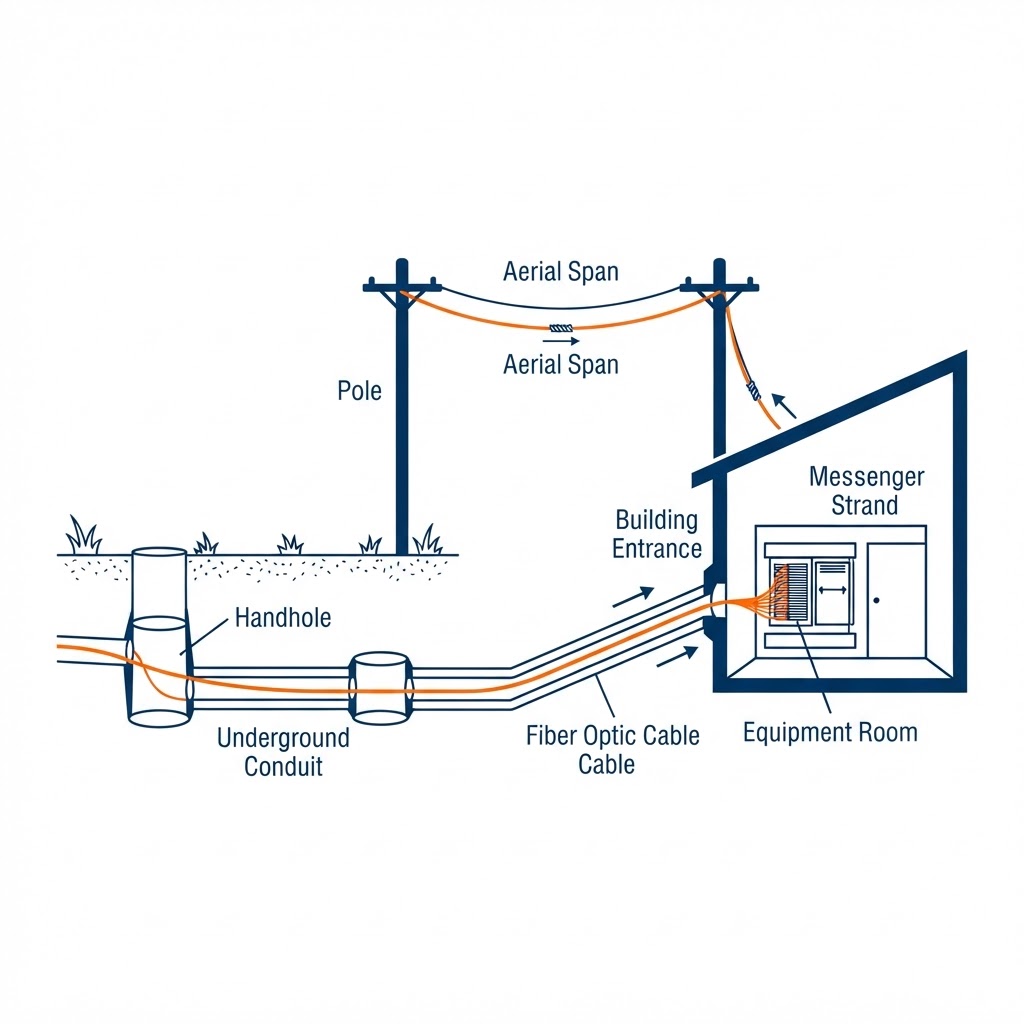
Aerial
Strand-mounted fiber and copper between buildings or across a campus — designed to NESC clearance requirements, coordinated with the utility for pole attachments and make-ready work, and documented with GPS-referenced pole and span records. We engineer for a diverse aerial path where the topology permits it.
Buried
Direct-buried and conduit systems installed via trenching, boring, or HDD depending on surface conditions, utility density, and restoration requirements. Every buried run is GPS-logged to the inch, staked at vaults and pull-boxes, and handed off with a depth record and as-built drawing your next contractor can actually use.
Campus Reticulation
The conduit, vault, and handhole infrastructure that ties a campus together — sized for today's fiber count and tomorrow's additions. Healthcare campuses, CCRCs, school districts, and multi-building industrial sites need an OSP backbone that doesn't require a full rebuild every time a new building comes online. We design for spare capacity from the start.
Inter-Building Risers
The transition from OSP backbone to inside plant: entrance conduits, protectors, grounding, and riser routing designed to TIA-568 and NEC Article 800. This is where most OSP projects get handed off to someone else and the drawing set stops being accurate. We own it end-to-end.
Last-Mile Coordination
When the project requires a carrier circuit — fiber entrance, dark fiber, or a leased WAN path — we manage the carrier coordination alongside the self-performed work. One PM, one scope, one schedule. You're not running parallel conversations with a carrier rep and a low-voltage sub who've never spoken to each other.
OSP Locates
Illinois One Call (JULIE) coordination, private-utility locating for campus systems, and ground-penetrating support for sites with undocumented or poorly documented buried infrastructure. Before a crew puts a blade in the ground, we know what's there — or we find out.
Who This Is For
- Healthcare campuses and hospital systems needing diverse-path fiber between buildings
- Senior living CCRCs and multi-building assisted living campuses
- K–12 school districts and higher education campuses on summer construction schedules
- Manufacturing and industrial facilities standardizing plant-floor network backbones
- Multi-building office parks and property portfolios
- General contractors and A&E firms who need a credentialed OSP sub with stamped drawings
How a Nexus OSP Engagement Runs
Phase 1 — Feasibility Walk
1–2 weeksA Nexus OSP engineer walks the site and reviews available records — plats, utility maps, existing conduit schedules. The output is a feasibility memo: proposed routes, estimated conduit fill, permit complexity, and a rough-order-of-magnitude cost range before you commit to full engineering.
Phase 2 — Engineering & Design
2–4 weeksStamped outside plant drawings: route plan, conduit schedule, vault and handhole placement, splice plan, grounding design, pole attachment permit exhibits, and a bill of materials. For healthcare and campus clients, we design a diverse path by default. Drawings are submitted to the AHJ and utility for approval as part of scope.
Phase 3 — Permits, Locates, Make-Ready
Schedule-drivenWe own the permit applications and One Call tickets — JULIE plus any private-utility locates required on campus. Pole attachment make-ready orders go to the utility under our account. We track the schedule and escalate delays. Most schedule risk on OSP projects lives in this phase; we've learned to front-load it.
Phase 4 — Install
VariesSelf-performed aerial, buried, and vault work in Illinois, Indiana, and Wisconsin. For projects requiring specialty equipment or out-of-territory restoration, we deploy a PM-managed partner crew under the same drawings, same quality checklist, and same Nexus PM accountability. No surprises at the handoff.
Phase 5 — Splice, Test, Document
IncludedFusion splicing, OTDR testing on every span (single-mode and multimode), end-to-end continuity, and a test-results package that travels with the as-built drawings. GPS-logged vault and handhole locations are recorded during installation — not reconstructed from memory after the fact.
Phase 6 — Manage
OptionalOSP systems fail at the weakest point: the splice closure nobody checked, the conduit fill nobody tracked, the handhole that filled with water. Our optional OSP maintenance agreement covers periodic inspection, splice tray audits, and same-day emergency response for cut-fiber events.
What Sets Our OSP Apart
| Typical Low-Voltage Sub | Nexus OSP |
|---|---|
| "We don't do outside." | Self-performed across IL, IN, WI |
| Refers you to a carrier or third party | Single accountable PM end-to-end |
| Drawings from the manufacturer's BOM | Stamped engineering, designed for diverse path |
| Skips make-ready coordination | Owns pole attachments and utility permits |
| "As-built" = pencil on a print | GPS-logged vaults, OTDR results, splice plans |
| Disappears after closeout | Optional managed-service maintenance |
Standards We Design To
- TIA-758-B (Customer-Owned OSP Telecommunications Infrastructure)
- ANSI/TIA-568, -569, -606, -607
- NEC Article 800 (Communications Circuits)
- RUS / Telcordia general requirements
- NESC (National Electrical Safety Code) clearances
- Illinois One Call / JULIE — 811 coordination
- IDOT + municipal ROW permitting
Equipment & Capabilities
Self-Performed
- Aerial installs up to [X] feet spanTBD
- HDD up to [X]"TBD
- Direct-buried trenching
- Fusion splicing
- OTDR testing — single and multimode
- Vault and handhole sets
Partnered — Nexus PM-Managed
- Mainline HDD beyond [X] feetTBD
- Restoration in regulated ROW outside IL
- Specialty crossings (rail, navigable waterway)
Project Examples
Healthcare Campus — Suburban IL
4,800 ft diverse-path 96-strand single-mode between two hospital buildings across a shared parking structure and campus drive. Aerial on existing poles + buried in conduit through the parking structure. Permit coordination with the municipality and the utility. 8-week construction window aligned with the hospital's low-census period.
K–12 District — Northern IL
Aerial and buried plant connecting 3 outbuildings and an athletic complex to the main school. 8-week summer construction window. All work completed before staff returned in August. Permitted through IDOT for the buried crossing under a state road.
Senior Living CCRC
Perimeter camera and access control reticulation across 14 residential cottages. New conduit and vault infrastructure sized to carry both current security systems and future network expansion. GPS-documented, installed during occupied operations with zero resident disruption.
Talk to an OSP Engineer
Tell us about the project — site, approximate distance, and route type — and an OSP engineer will confirm scope and feasibility, usually within one business day.